How Much to Spend on Christmas Gifts per Child (and per Person) in 2026
Surveys put US parents at about $521 per child and gift lists at $628 per person. How to set your own number: total first, then per person, then track it.
There’s no correct amount, but there are useful benchmarks. In a November 2025 survey, US parents planned to spend $521 per child on Christmas gifts. For the whole gift list, the National Retail Federation’s 2025 survey put the average at $628 per person, and Gallup’s at $1,007.
Your own number should come from the other direction: start with the total you can pay off by January, then split it per person. Here’s what people spend, a method for setting your amounts, and how to keep to them once the shopping starts.
What people spend on Christmas gifts
These were the latest figures when we wrote this in late October 2026:
| Survey | Season | Average | What it measures |
|---|---|---|---|
| Deloitte | 2026 | $1,654 | The whole season, per household; $988 of it on retail goods |
| Gallup | 2025 | $1,007 | Holiday gifts, adults’ own estimate |
| NRF / Prosper | 2025 | $628 | Gifts for family and friends per person |
| CouponBirds | 2025 | $521 | Gifts per child, parents’ plans |
| What to Expect | 2024 | $173 | Gifts per child, moms of children up to age 5 |
The numbers disagree because they ask different people different questions: the whole season or gifts only, every adult or parents of toddlers. Treat them as a range, not a target.
Income moves the numbers a lot. In Gallup’s 2025 poll, households under $50,000 expected to spend $651 on gifts, and households at $100,000 or more $1,479. Deloitte’s 2026 survey shows the same pattern for the whole season: $693 for households under $50,000, $3,607 at $200,000 and up.
The NRF data also shows how the list splits. Among people buying for each group in 2025, the planned totals were $496.70 for family, $121.50 for friends and $102.27 for coworkers. Those are totals for the whole group, not per person.
How much to spend per child
The benchmarks run from $173 to $521 per child, which tells you mostly that families do this very differently. A few things change the right number for yours:
- How many children you have. In the What to Expect poll, moms of one child planned $202, and moms of two or more $170 per child.
- Age. A toddler’s gifts cost less than a teenager’s wish list. Plan for the gap rather than pretending it isn’t there.
- Who else gives. Grandparents, aunts and godparents may cover part of the list. Agree on who buys the big item, so a child doesn’t get two.
- Equal money or equal count. Pick one rule and keep it every year. Equal money is easier to budget; equal count is easier to see under the tree.
One structure that keeps the count in check is four gifts per child: something they want, something they need, something to wear and something to read. A fixed count makes a fixed budget easier to hold, because the pile can’t quietly grow.
A method: total first, then per person
1. Set the total from cash, not hope. Add what you’ve set aside to what you can spare from November and December pay without carrying a card balance into January. Debt is the cost the averages hide: 37% of US consumers took on holiday debt in the 2025 season, averaging $1,223 in a LendingTree survey. In the CouponBirds survey, 58% of parents expected to borrow for Christmas.
2. Take out everything that isn’t a gift. Food, hosting, travel, decorations, cards and wrapping. In the NRF’s 2025 survey, food, decorations and cards alone were $262.56 of the $890.49 average, about 30%, before any travel.
3. List everyone, in tiers. Children and partner first, then parents and siblings, close friends, then teachers, coworkers and neighbors. Give each tier one per-person amount.
4. Keep a buffer. About 10% of the total covers the person you forgot, shipping and the extra stocking filler.
5. Add it up, then cut a tier, not everyone. If the list comes out over, change a whole tier: a family name draw instead of a gift for every sibling, one gift per household instead of per person, a group gift for a teacher.
Say your total is $1,500. Food and hosting take $300, decorations, wrapping and cards $100, and you keep $100 as the buffer. That leaves $1,000 for gifts:
| Who | People | Each | Total |
|---|---|---|---|
| Kids | 2 | $225 | $450 |
| Partner | 1 | $200 | $200 |
| Parents and in-laws | 4 | $40 | $160 |
| Sibling (family draw) | 1 | $50 | $50 |
| Close friends | 4 | $25 | $100 |
| Teachers and coworkers | 4 | $10 | $40 |
| Gifts total | $1,000 |
The budget breaks while you shop, not while you plan
The big gifts are usually planned. The overspend hides in the second gift for the same person, express shipping and the stocking fillers bought at the checkout.
The season is also long. In the NRF’s 2025 survey, 42% of shoppers planned to start before November and 60% expected to finish in December. Whether your budget month starts on the 1st or on payday, Christmas spending crosses at least two of them, often on several cards, and a monthly budget sees it in pieces.
So track the season as one number, and each purchase against the person it’s for. A notebook works if you update it every time you pay. What matters is a running total you trust.
Do it in Lode
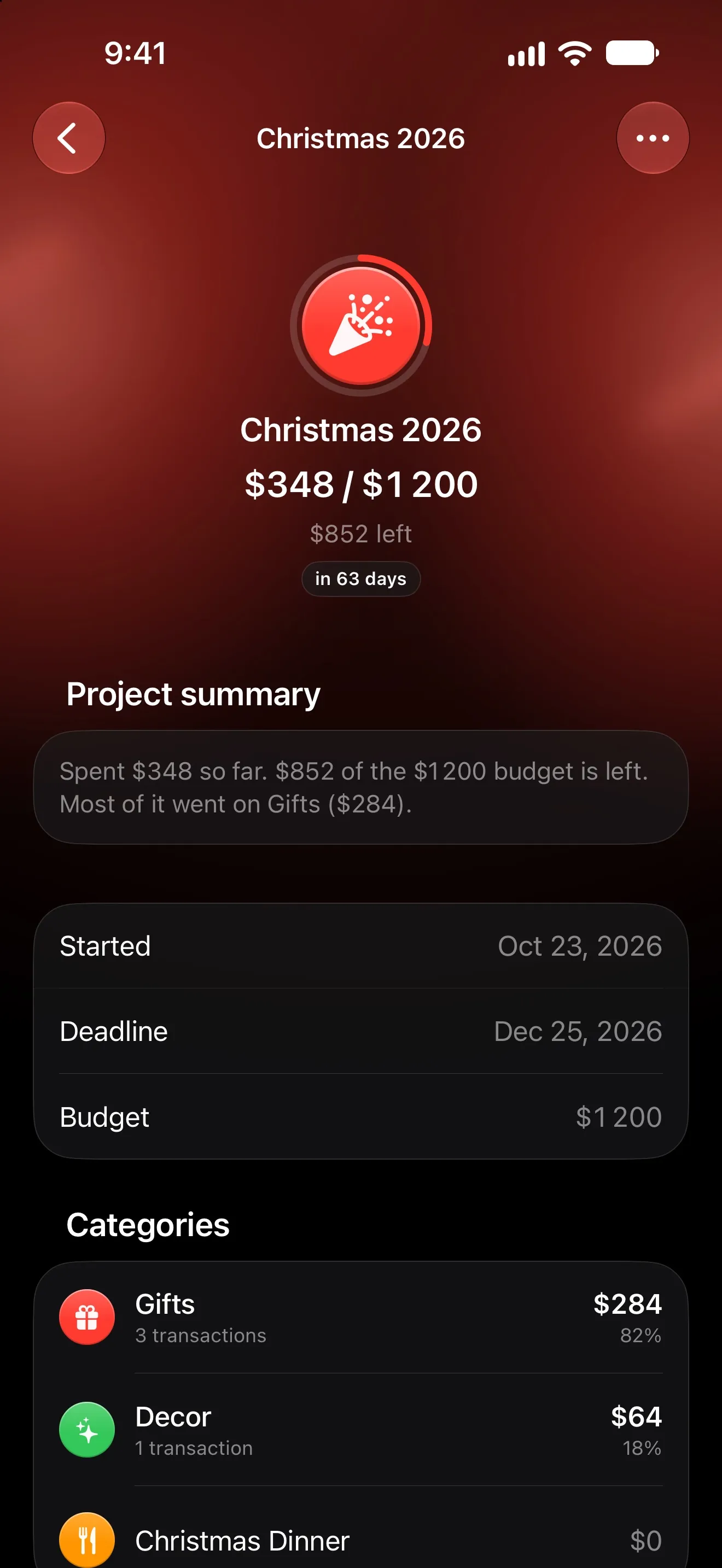
In Lode, the season fits a project: a one-off effort with its own budget and categories.
- Touch and hold + on the Dashboard and choose Project. Name it “Christmas 2026” and enter your total as the Budget.
- Use Add category for each tier: Kids, Partner, Family, Friends, Work & school, Food & hosting. A project can have up to 12, and they appear in every category picker as “Christmas 2026 > Kids”.
- Turn on I know the deadline and set December 25. Lode reminds you a week before and on the day, with how much is left.
- Leave Keep out of the monthly Budget on, so December’s monthly budget still tells you about groceries and rent rather than presents.
Anything filed under those categories counts, whatever its date: the October early purchase and the January return alike. A refund recorded as income in one of the project’s categories is subtracted from what it spent. The project page shows spending against the budget, what’s left or how far over you are, and what each category has cost.
Two limits to know. The project’s budget is one number, so keep the per-person amounts in its Note and compare them with the category totals yourself. And Lode doesn’t connect to your bank: purchases arrive when you log them, or automatically from bank notifications (iOS 27) and Apple Pay taps.
The free plan includes one project, and a project’s categories don’t count toward the free category limit.
When it’s over, write down what it cost. If January hurts, a savings goal for next December spreads it out: $1,200 is $100 a month.
FAQ
Is $100 per child enough for Christmas? If it’s what you can pay without borrowing, yes. In CouponBirds’ 2024 survey, only 4% of parents planned to spend under $100 per child, but averages include high earners and families going into debt for it.
Should I spend the same on each child? Choose equal money or an equal number of gifts and stay consistent from year to year. If your children are far apart in age, equal count is often easier, because an older child’s gifts tend to cost more.
How much should I spend on a coworker? If your workplace runs a gift exchange, its price cap is the answer. In the NRF’s 2025 data, about a third of shoppers planned to buy for coworkers at all, and they budgeted $102.27 for all of them together.
What percentage of income should go to Christmas? There’s no standard rule, and averages swing widely with income. A better test is cash: if the total can be paid by the end of January without a card balance, it fits.